
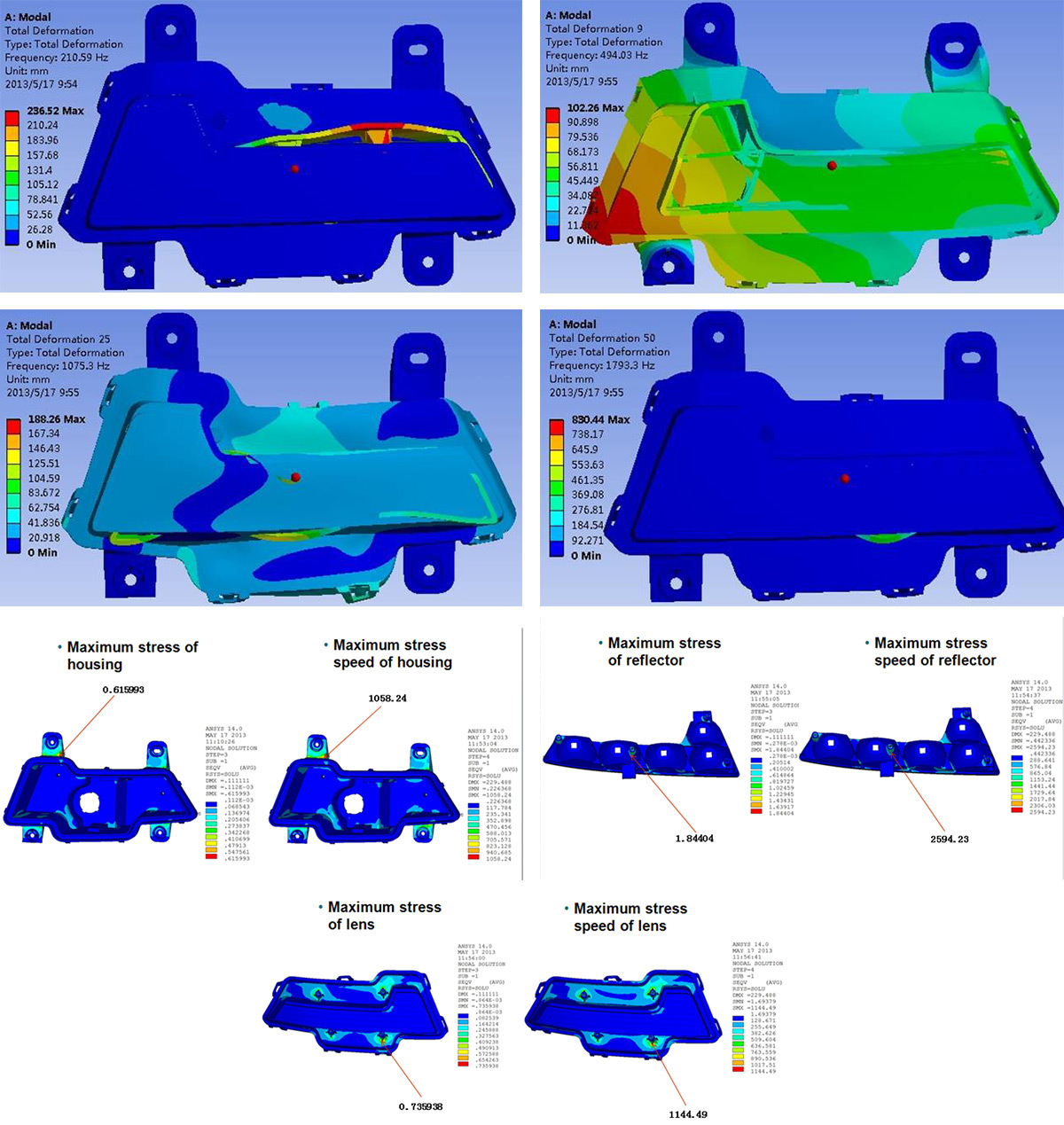
1. By vibration simulation analysis, we can get the stress and the highest of stress speed of each part.
2. Then, unified computing with the fatigue life of the material, we can judge if the chosen material is qualified to the resistance requirements.
| Vibration Frequency(Z) | Power Density Spectrum |
| 10 | 0.208 |
| 55 | 0.0677 |
| 180 | 0.0026 |
| 300 | 0.0026 |
| 360 | 0.00146 |
| 1000 | 0.00146 |
| No. | Part Name | Material | Density | Elasticity Modulus | Tensile Strength | Poisson's ratio |
| 1 | Lens | PC | 1200 | 2400 | 67 | 0.3 |
| 2 | Reflector | PC | 1200 | 2400 | 67 | 0.3 |
| 3 | Housing | PP+TD20% | 1040 | 1800 | 20 | 0.3 |
| Part | Stress(MPa) | Stress(MPa) | Actual cycle number | Damage | Total damage |
| Lens | 1σ(0.74) | 1.64E24 | 5.32E7 | 3.24E-17 | 7.14E-13 |
| 2σ(1.48) | 5.69E20 | 5.24E7 | 9.21E-14 | ||
| 3σ(2.22) | 5.39E18 | 3.35E6 | 6.22E-13 | ||
| Housing | 1σ(0.62) | 1.15E19 | 1.25E8 | 1.08E-11 | 2.09E-07 |
| 2σ(1.24) | 4.01E15 | 5.05E7 | 1.25E-08 | ||
| 3σ(1.86) | 3.79E13 | 7.93E6 | 2.08E-07 | ||
| Reflector | 1σ(1.84) | 4.66E19 | 4.86E7 | 1.04E-12 | 2.13E-08 |
| 2σ(3.68) | 1.61E16 | 2.11E6 | 1.30E-09 | ||
| 3σ(5.52) | 1.52E14 | 3.06E6 | 1.99E-08 |
The total damage of reflector , housing , lens is less than 1, so the fatigue damage will not happen
Tel:+ 86-576-84203933
Fax: +86-576-84203922
Email:djcn@djcn.com.cnAdd:No. 25, Chaoyuan Road, Xinqian Development, Huangyan, Taizhou, Zhejiang

 Company Profile
 Memorabilia
 Honor
Honor Benefit
 Headlight Mould
 Rear Light Mould
 Light Guide Mould
 BMC Reflector Mould
 Mould Design
 Optical Design
 Mold flow analysis
 Thermal simulation
 Vibration simulation
 Equipment
 Quality Control